


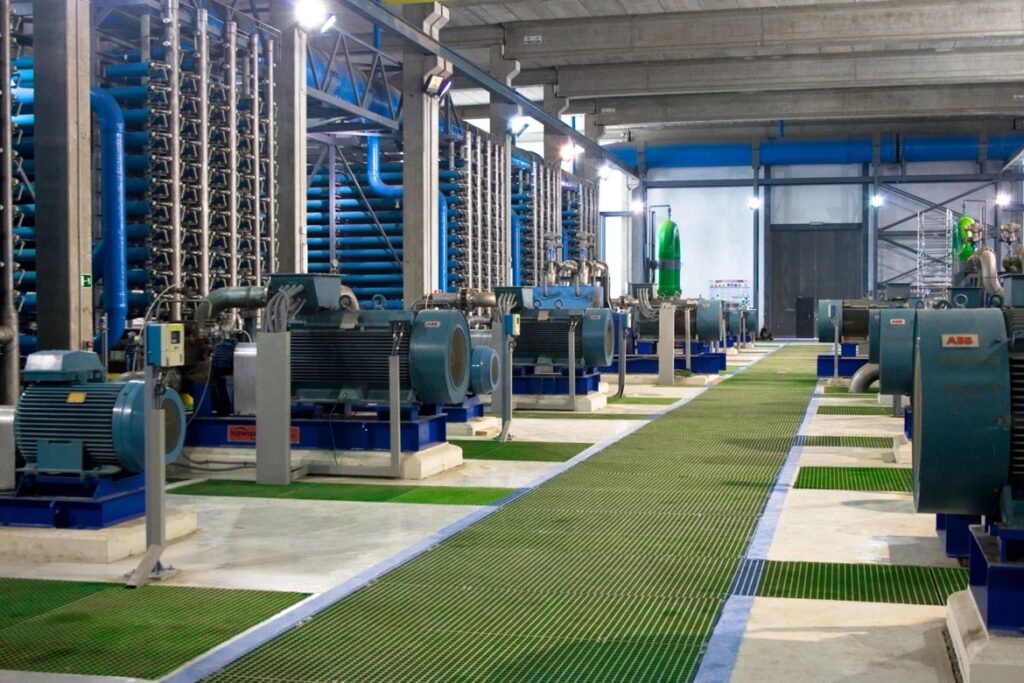
On July 8th, a major step forward in water security for the Costa del Sol was officially marked with the inauguration of the expanded Marbella Desalination Plant. Presided over by the President of the Andalucian Government, Juanma Moreno, the event celebrated the culmination of a multi-phase project that has restored the plant to its original capacity of 20 hectometres per year—enough to supply between 15% and 20% of the region’s total water needs.
This is not just a technical upgrade—it’s a lifeline. With persistent droughts and increasingly erratic rainfall patterns, Andalusia has found itself on the frontline of Spain’s water crisis. The expansion of Marbella’s desalination facility is both a symbol of resilience and a practical solution to the growing pressure on natural water sources.
A Project in Two Phases
Work on the plant began in earnest in 2024. The first phase, completed by autumn of that year, focused on modernising the membrane and reverse osmosis systems, boosting output from a diminished 6 hm³ up to 12 hm³ annually. The second and final stage, completed this past May, added the final stretch—raising capacity to 20 hm³, thanks to new infrastructure and energy-efficient upgrades.
The total investment has reached nearly €17 million, with the Andalusian Energy Agency and European funds contributing to a €10 million injection for energy optimisation. The upgraded facility now operates with improved sustainability and reduced emissions—another key target in the region’s long-term environmental planning.
A Regional Solution
More than a local fix, the plant plays a key role in the broader strategy to interconnect water networks across Malaga province. Thanks to a web of pumping stations, reservoirs and transfer systems, water can now be moved between Marbella, the Axarquía region, and the city of Málaga—making the desalination plant an anchor point in a flexible, responsive system.
With tourism surging and the summer population in coastal towns tripling, the return to full capacity couldn’t come at a better time.
Leadership and Vision
During the inauguration, Juanma Moreno didn’t shy away from pointing fingers, noting that previous administrations had left the plant idle and underused. “Once again, this regional government has had to come to the rescue,” he said. “The Costa del Sol now has a desalination plant producing 20 hm³ a year—no small achievement in the face of climate adversity.”
Moreno also highlighted that since 2019, the Andalucian Government has invested nearly €2 billion in water infrastructure, with over 100 projects in motion.
Looking Ahead
This expansion forms part of a wider Non-Conventional Water Resources Strategy, which aims to deliver 160 hm³ of desalinated water and 180 hm³ of reclaimed water annually by 2027. New facilities are also in the pipeline, including a planned treatment plant on the Río Verde (€39 million) and the development of another desalination plant in the Axarquía region.
A Fresh Chapter
For the Costa del Sol, this is more than the relaunch of an old plant—it’s the beginning of a new era in smart water management. At a time when many Mediterranean communities are reckoning with the limits of traditional reservoirs and aquifers, Marbella stands out as a model of forward-thinking investment in infrastructure.
Water may be the most basic human need—but in 2025, ensuring it reaches our taps is anything but simple. Thanks to projects like this, however, the Costa del Sol is turning the tide.


