


A walker is injured on a mountain path. A driver reports a collision on the motorway. Smoke rises from woodland above a town. Each emergency calls for a different response, but in Andalucia they can all begin with the same three digits – 112.
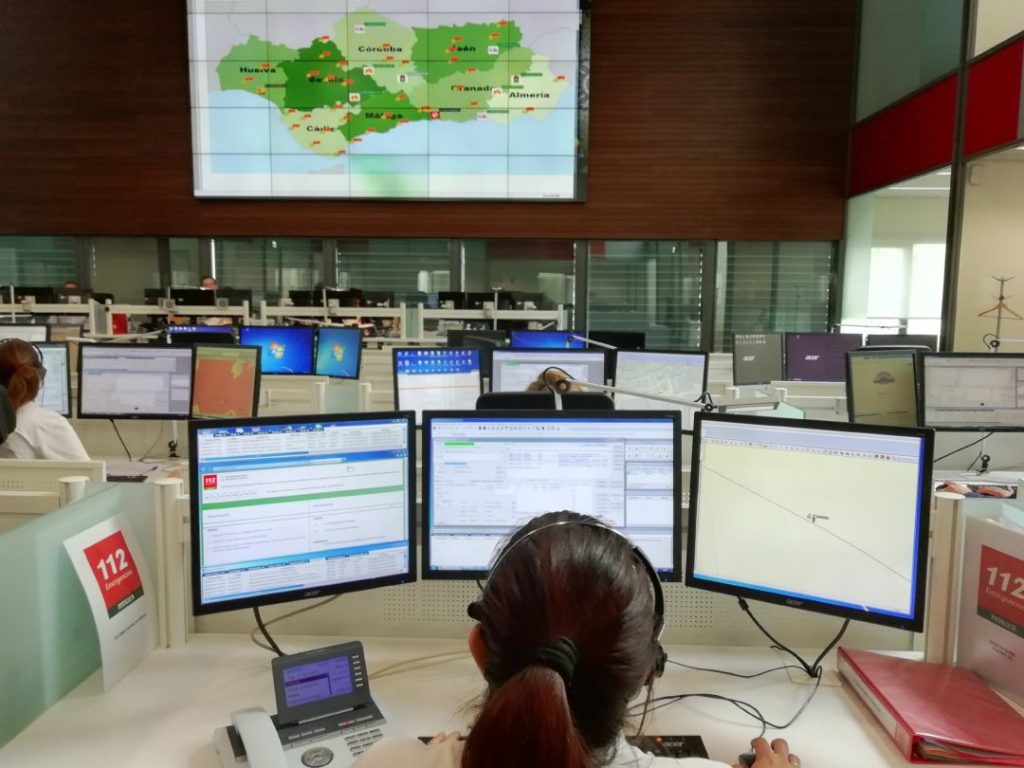
At the emergency centre in Málaga’s technology park, the first task is to establish what has happened and where. The building houses a regional 112 call room and a provincial coordination room, alongside Málaga’s Civil Protection service and INFOCA’s Provincial Operations Centre. Its regional call room also handles alerts from eastern Andalucia, so the centre’s work extends well beyond Málaga province.
Ana Celia González, the centre’s director and head of the Civil Protection service, explained that answering calls is only part of its job. During a forest fire, flood or other major crisis, the centre helps bring the responding organisations together and keeps information moving between them. The Andalusian Emergency Agency’s first priority, she said, is protecting people.
What happens when someone calls?
For the caller, the first questions are simple: What is happening, and where? An operator must obtain clear answers even when someone is frightened, injured or unable to give a precise location. González said that calls made to 999 or 911, the emergency numbers familiar to people from the UK and United States, are automatically connected to 112 in Andalucia.
Once the situation is understood, 112 alerts the services needed and follows the incident as it develops. Those services can include healthcare teams, firefighters, police, INFOCA, the Military Emergencies Unit, the Red Cross, utility companies and maritime rescue. Some incidents require several of them at once. 112 coordinates their response; specialist teams carry out the work on the ground.
González said the centre handles well over a million calls a year for Málaga province, with many alerts passed to other organisations. The figure refers to calls, which should be distinguished from the number of separate emergencies coordinated. Behind every call is the same practical aim: to get accurate information to the people who can help, as quickly as possible.
A centre built for a demanding province
Málaga is consistently one of Andalucia’s busiest provinces for emergency coordination. In the regional government’s 2024 annual report, 112 coordinated 177,249 incidents in Málaga, the second-highest provincial total after Sevilla. That is an average of about 484 incidents a day. Across Andalucia, the service handled 3,449,145 calls and coordinated 819,053 emergencies that year. Calls and coordinated incidents are different measures: an incident may generate multiple calls, while not every call results in an emergency response.
The demands change with the season, for example the population in Malaga province tripling during the summer months. Across Andalucia in 2024, August was the busiest month for coordinated incidents, followed by July and June. The Junta links the summer rise to holiday travel, tourism and increased outdoor activity. In Málaga, that seasonal pressure comes on top of the everyday calls from its cities, coastal resorts, roads, countryside and mountains.
The Málaga centre moved to its current premises on Calle Severo Ochoa in the technology park after years at Avenida de la Aurora. The new building increased the planned number of workstations from 15 to 26 in the regional room and from five to 12 in the provincial room. It also brought space for crisis coordination, meetings and training. The upgrade included an uninterruptible power supply, a new data-processing centre and a video wall. Interestingly the site was also chosen for its low risk of flooding or fire.
The technology behind the call
The operators’ central tool is GEA, Andalucia’s emergency management platform. It helps staff record and locate incidents, manage information as it develops and share updates with the organisations involved. During a major emergency, the same evolving picture can be made available to 112 centres, operational coordination rooms and forward command posts. That is particularly valuable when a flood or wildfire affects several places at once and decisions must be made using the latest information.
Callers can also use the free 112 Andalucía app. When location is enabled, pressing its 112 button connects the caller to the centre and sends positioning coordinates at the same time. It can be especially useful when someone knows they need help but cannot describe their location accurately. Vehicle technology offers another route in: Andalucia’s 112 service received 20,859 calls through the automatic eCall system in 2024.
Language is part of the service too. The Junta’s 2024 annual report records 43,845 calls handled in languages other than Spanish, including 33,076 in English. The report also lists French, Arabic, German and Ukrainian. For a province with a large international population and millions of visitors, being able to explain an emergency clearly can make a material difference to the information reaching responders.
One figure gives a sense of the pace in the call rooms. In 2024, the average time between dialling 112 and an operator answering was 4.68 seconds across Andalucia. It measures how quickly a call is picked up, rather than how long an ambulance, fire crew or police patrol takes to arrive.
INFOCA under the same roof
Forest fires require their own specialist command structure. Málaga’s INFOCA Provincial Operations Centre, or COP, is based at the 112 building on Calle Severo Ochoa. Its responsibility covers the province: receiving information about forest fires, preparing the daily deployment according to risk, mobilising and coordinating firefighting resources, monitoring operations and reporting to INFOCA’s regional operations centre. The provincial centre has land and air resources assigned to it; it is a coordination base, rather than the place from which all crews are physically dispatched.
When a suspected forest fire is reported to 112, the two services have distinct, connected jobs. 112 handles the public alert and coordination with other emergency organisations; INFOCA directs the specialist forest-fire response. As an incident grows, those links become increasingly important. Fire crews may need police to close roads, healthcare teams to prepare for casualties and Civil Protection teams to help manage the effects on nearby communities. This description follows the services’ published responsibilities; the precise response depends on the incident.
INFOCA’s work also begins before flames are reported. Its provincial centre reviews the risk and readiness of its resources each day. The 2026 regional catalogue identifies forest-defence centres serving Málaga at Colmenar, Sierra de las Nieves and Ronda, as well as a specialised brigade base at Cártama. Across Andalucia, the catalogue lists thousands of personnel* who can participate in the forest-fire campaign. Those are regional figures, rather than a count of people working in the Málaga building.
Communications must hold together across a fireground, vehicles, aircraft and command centres. The Junta’s REJA digital emergency radio network serves 112, INFOCA and other regional emergency services. Its 2026 catalogue describes 146 fixed bases across Andalucia and capacity for up to 1,000 simultaneous calls, including group communications. INFOCA also uses dedicated air-band radio equipment to communicate between ground teams and aircraft.
*INFOCA’s 2026 operation has 577 personnel assigned across Málaga province, forming part of a 4,700-strong regional operation
Most people will never see the Málaga centre at work. Its value is clearest when one incident crosses several boundaries at once: a fire that threatens homes, a road collision that requires rescue and medical care, or flooding that affects whole communities. Behind a single call to 112 is a team gathering facts, sharing them and keeping the response connected as the situation changes.


